We are hot. But we're not hot like a broody chicken. Due to some combination of temperature, season, and chicken hormones, Fluffernutter decided she was determined to sit in the nest box until she either hatched a baby chick or died, whichever came first. In other words, she became broody.
Ah Fluffernutter, our perpetual problem chicken. First to discover that the top of the electric outlet in the coop is the most desirable perch, perpetrator or two separate egg eating incidents.
It took us a few days to discover she'd ceased to leave the nest box, and then another few to realize we were supposed to do something about it (given that we don't have a rooster and the possibility of her hatching an egg being non-existent).
Various wisdom on breaking broody chickens includes:
- Simply pull the hen off the nest box as soon as you notice it (works best if caught in the first few days before the habit is set)
- Confine the broody hen to an area without good nesting spots (wire cage, chicken tractor)
- Dunk the hen's bottom in cold water
Option 1 resulted in Fluffernutter walking around a bit disoriented for awhile and then going back to the nest box. Option 3 seemed kind of mean. Since we had the chicken tractor handy we decided to stick her in there with some food and water and treats. I don't know if chickens can actually cry, but she did her best imitation of sobbing. I am a soft hearted farmer, I'm not going to lie, it was sad.
The other chickens gathered around the outside of the tractor in what I thought was concern, but then, twelve hours later when we opened the door it turned out they just wanted to get into the tractor and eat the untouched treats. Poor Fluffernutter, who had been sitting in there all day, was immediately blocked from the exit by 11 other chickens squeezing in with her.
This went on for three days, with one of us having to physically move her off the nest box and onto a perch every night after all the chickens had settled in to roost (we even let her sit on the electric box). Finally, after a few days in the sun, she doesn't seem disoriented anymore and is venturing out on her own. Our total egg production however, has dropped by half. Are the chickens stressed out by all the drama or just the heat? I guess time will tell. Fluffernuter seems to be feeling better, but the forecast says the heat is here to stay.
Showing posts with label Chickens. Show all posts
Showing posts with label Chickens. Show all posts
Tuesday, June 16, 2015

Wednesday, April 1, 2015
Strong fences make sane farmers
J already apologized for the lack of recent posts, so I wont do so again, but rest assured, I had good reason. The reason being:
THE CHICKENS ATE MY VEGETABLE SEEDLINGS
No amount of bolding or readily available fonts can accurately convey the appropriate level of horror and despair. I have only just emerged from a fog of sadness and moping to tell you about it.
This happened while J was away in South Africa. Prior to leaving he built and posted about a new greenhouse we were trying. For a full two weeks it proudly presided over our backyard, gently heating (or being heated by) the mound of straw and compost we'd piled in there. Meanwhile, I carefully prepared my seedlings for the long journey from the top of the boiler to the kitchen window, and finally, their first day outside in the greenhouse.
The great day arrived. I stocked the greenhouse with plants and then went off only to come home to find the greenhouse blown over and every plant ripped to shreds. The plants weren't necessarily eaten- just strewn about among the pots and scattered soil like the day after a chicken kegger.
Anyone that knows me knows that I love plants. Possible more than people (sorry). Definitely more than chickens. I suppose I could have been mad at J and his carpentry skills or the wind or myself for putting ALL of my brassicas out on the first day, but I wasn't. I was mad at the chickens and everything they did filled me with rage.
And so I made a fence around the coop with a bunch of log/sticks and deer netting. Luckily the soil had just thawed and it only took about an hour to dig the holes and get everything set up.
The chickens were confused at first, and I felt bad about confining them. But then I looked at my dying plants and hardened my heart and said "haha suckers, chicken jail for you!"
And then they escaped through a gap I hadn't sealed well and, because they can't really see the fence netting, they then spent the next 20 minutes body slamming themselves against it in an increasing panic as they tried to get back to their coop (but also evaded my assistance). At least now they seem traumatized enough by the experience to not want to escape anymore. For the most part they don't seem to care that they're confined, unless they see a human in the yard and decide they want attention (which is always). Then they gather at the side and do this:
So now instead of the chickens rushing over to the house and trying to trip me every time I open the back door, I'm greeted with a very pitiful chicken cacophony, which is especially grating when trying to have a meal at the picnic table outside.

Unfortunately, the netting we used for the fence is very flimsy and has now started ripping where we part it to enter and exit, resulting in an increasingly elaborate pile of things leaned in front of it to keep the chickens from accidentally wandering out until we can frame a real door.
Its mostly been working. But then of course the other day I was sitting by the window and saw a cardboard box roll by like a tumbleweed. I went out to get it, and found that our door-barriers had blown down and the chickens had wandered out. So what do they do with five minutes of freedom and 4.5 acres at their disposal?

THE CHICKENS ATE MY VEGETABLE SEEDLINGS
No amount of bolding or readily available fonts can accurately convey the appropriate level of horror and despair. I have only just emerged from a fog of sadness and moping to tell you about it.
This happened while J was away in South Africa. Prior to leaving he built and posted about a new greenhouse we were trying. For a full two weeks it proudly presided over our backyard, gently heating (or being heated by) the mound of straw and compost we'd piled in there. Meanwhile, I carefully prepared my seedlings for the long journey from the top of the boiler to the kitchen window, and finally, their first day outside in the greenhouse.
The great day arrived. I stocked the greenhouse with plants and then went off only to come home to find the greenhouse blown over and every plant ripped to shreds. The plants weren't necessarily eaten- just strewn about among the pots and scattered soil like the day after a chicken kegger.
 |
| Greenhouse remains |
And so I made a fence around the coop with a bunch of log/sticks and deer netting. Luckily the soil had just thawed and it only took about an hour to dig the holes and get everything set up.
The chickens were confused at first, and I felt bad about confining them. But then I looked at my dying plants and hardened my heart and said "haha suckers, chicken jail for you!"
And then they escaped through a gap I hadn't sealed well and, because they can't really see the fence netting, they then spent the next 20 minutes body slamming themselves against it in an increasing panic as they tried to get back to their coop (but also evaded my assistance). At least now they seem traumatized enough by the experience to not want to escape anymore. For the most part they don't seem to care that they're confined, unless they see a human in the yard and decide they want attention (which is always). Then they gather at the side and do this:
So now instead of the chickens rushing over to the house and trying to trip me every time I open the back door, I'm greeted with a very pitiful chicken cacophony, which is especially grating when trying to have a meal at the picnic table outside.
Unfortunately, the netting we used for the fence is very flimsy and has now started ripping where we part it to enter and exit, resulting in an increasingly elaborate pile of things leaned in front of it to keep the chickens from accidentally wandering out until we can frame a real door.
Its mostly been working. But then of course the other day I was sitting by the window and saw a cardboard box roll by like a tumbleweed. I went out to get it, and found that our door-barriers had blown down and the chickens had wandered out. So what do they do with five minutes of freedom and 4.5 acres at their disposal?
And so I lost yet another tray of seedlings.
Wednesday, February 25, 2015
Energy Efficient Refrigerator Hack
We mentioned in our last update that we are a bit obsessive about energy use. How obsessive? Prior to all of the drama with our frozen pipes, we made a list of every appliance and phantom load in our house, its likely energy consumption in watts, and how many hours per day each appliance is in use in low, medium, and high energy consumption scenarios. It looked like this:

We then compared our range of total daily energy consumption from the table to our actual daily energy consumption from our electric company. The numbers matched up pretty well, although our actual allocation of energy use to specific appliances is just a ball park estimate.
Of course, we could have used an actual energy monitor that plugs into each individual outlet or our circuit breaker, but we don't have one and its probably for the best given our tendency to overanalyze...


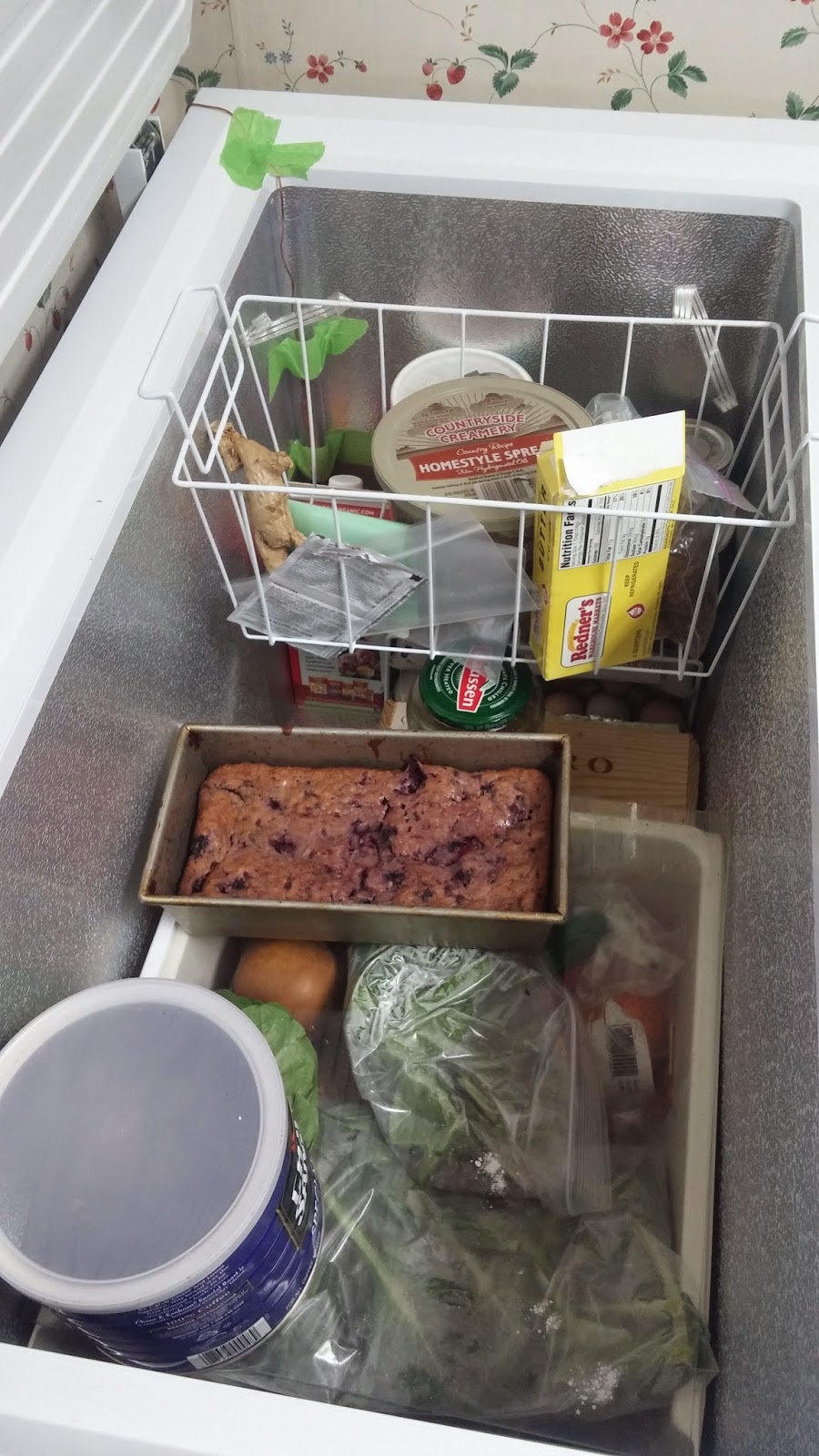 On the top layer we have a basket that slides from side to side. We're looking for a few more baskets with compartments to organize and store things we use often more securely. The current basket is a bit of a mess.


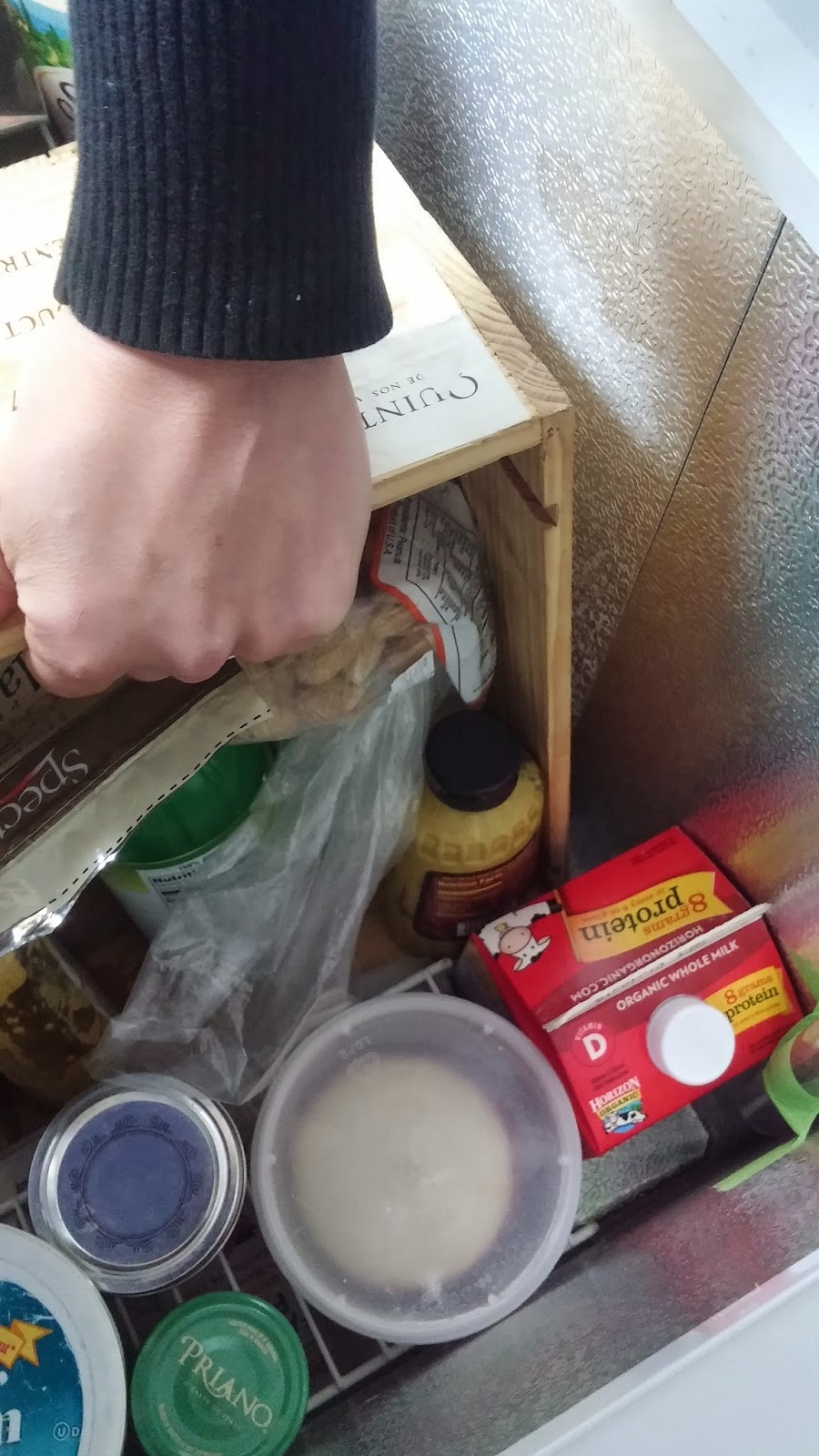
For now we also have another crate on the bottom layer that can be lifted up to rest on the built in ledge
Kind of a clunky first pass at organization with materials we have lying around. Once we have an idea of what works well for us we'll think about building something more permanent. This is probably as full as our refrigerator will ever get, since we had an amazing, large CSA basket gifted to us today by the same incredible person that helped us track down a plumber.

We then compared our range of total daily energy consumption from the table to our actual daily energy consumption from our electric company. The numbers matched up pretty well, although our actual allocation of energy use to specific appliances is just a ball park estimate.
Of course, we could have used an actual energy monitor that plugs into each individual outlet or our circuit breaker, but we don't have one and its probably for the best given our tendency to overanalyze...
 |
| High scenario: The 'computer' category assumes that we leave our desktop with an old monitor plus two laptops on for 24 hours (and the monitors don't go to sleep). The heat lamps and light in our well house are only on when its cold, but when it is, they're on all night. We're assuming that its cold AND wet, since the sump pump in this scenario is also working pretty hard. "Plants" refers to the fluorescent grow lights we use for seedlings. Our oven is gas powered, but has some auxiliary electric. We don't have cable or TV (see computers), which would be big energy consumers if we did. |
What stands out in all of our energy use scenarios is that our ancient water heater and refrigerator account for over half of our electric bill.
The water heater is going to have to wait for a little bit, as its a slightly larger purchase that will involve some professional plumbing and electric help and the payoff for switching it out isn't as immediate.
However, any excuse to get rid of the old, loud, big, in the way, difficult to close refrigerator! We did some research and what we found was disappointing. The most efficient Energy Star non-dorm sized refrigerators (over 7cu ft) start at 249 kWh/yr, with most using over 300 kWh/yr. That isn't so much, but in comparison, similarly sized chest freezers start at 189 kWh/yr to keep food substantially colder.
Most of the difference has to do with the basic layout. When you open a chest freezer, most of the cold air stays down at the bottom, whereas when you open a standard refrigerator door, all of the cold air comes pouring out towards you. The chest freezer is also better insulated and you never have to worry about the door popping open (unless you over pack it).
Chest freezers are also substantially cheaper, as they are basically just a box. No shelves. No drink dispenser. No ice maker. Just box.
So we did some thinking. Our kitchen is small and limited in counter space. Pretty much any upright refrigerator would partially block our lovely wall cabinet. How attached were we to conventional shelves? We pretty much only use the front 6" inches...the backs of the shelves being a graveyard for unlabeled jars and old mustard. Did we want a drink dispenser? no. Did we want an ice maker? no. Did we even want a freezer compartment?
An investigation of our freezer revealed 10 ice packs, a single Tupperware of frozen berries, and 6 zip lock bags of malted barley from the last time we made beer. But what if someday we want to buy ice cream? What if someday we actually have leftovers that stick around for more than two days?
We ultimately decided on buying two chest freezers and a temperature controller (still cheaper than one refrigerator). The larger chest freezer came with an energy rating of 248 kWh/yr. Not particularly good for a freezer, but still better than the best refrigerator, and for our purposes it doesn't really matter. We hooked it up to the temperature controller, and voila...a 7.2 cu ft, better than 248 kWh/yr, refrigerator.
We stripped our old refrigerator of its shelves and made a sort of sliding box system inside of the chest freezer...ahem...refrigerator.
Somehow I never took a good picture of our old refrigerator before we moved it, so this is the most comparable before-after I can come up with:
Before After
You can see the discoloration on the floor where the old refrigerator used to be. The new chest refrigerator takes up about the same floor area as the old refrigerator, just in a slightly different orientation.
In the back corner we have the temperature sensor part of the temperature controller hanging inside of a plastic tube we happened to have (for protection) and not so neatly taped in place with painter's tape. The actual temperature regulator sits in the corner behind the refrigerator.
On the top layer we have a basket that slides from side to side. We're looking for a few more baskets with compartments to organize and store things we use often more securely. The current basket is a bit of a mess.
On the second layer, we have a drawer from our old refrigerator (with glass shelf on top for a cover). The glass cover slides over to give access to the contents of the drawer. The entire drawer also slides out of the way to give access to a third layer (milk crate covered with freezer shelf).
For now we also have another crate on the bottom layer that can be lifted up to rest on the built in ledge
Kind of a clunky first pass at organization with materials we have lying around. Once we have an idea of what works well for us we'll think about building something more permanent. This is probably as full as our refrigerator will ever get, since we had an amazing, large CSA basket gifted to us today by the same incredible person that helped us track down a plumber.
As for the freezer, we ordered a smaller Energy Star chest freezer that we'll keep somewhere out of the way and only use as we need it (or get a second temperature controller so it can double as an overflow fridge). We ate the berries we had frozen and are feeding the defrosted malted barley to the chickens (who LOVE it).
Some of the other old refrigerator shelves have temporarily been installed in our utility/laundry room to hold our garden seedlings. No shelf in our house is safe from plants!
Keep reading:
Friday, January 30, 2015
Tuesday, January 27, 2015
Week 4 egg production stats and egg eating update
 |
| We're averaging eight eggs a day, not including the two that were eaten by the chickens on Friday
The chickens have laid 74 eggs now...three dozen are boxed up and waiting to be delivered to new homes tomorrow. Some we gave away, and two dozen we ate ourselves...boiled, scrambled, omelets, bread, béchamel sauce, spaetzle. I was going to make and freeze a bunch of pasta, but it will have to wait until the chickens lay some more.
 
|
 |
| Ideas? |
On Sunday our neighbor brought us a bale of hay he grew, which set off a morning of cleaning out the coop, removing the cardboard boxes we brought the chickens home in, and installing more permanent nesting boxes. The chickens seem entertained by their new environment, although they only lay an occasional egg in the nest boxes we built. Their favorite spots are now behind the bike wheels in one corner and behind the new hay bale in the other corner.
We did however collect three slightly fractured eggs. Two of these were from the Auracana, who is always being chased off her nest and ends up laying in the middle of the floor. Hopefully having some more straw in the coop will help with this (so the eggs have a soft landing), but the chickens seem determined to express their creativity in finding awkward places to lay. They also sit with their heads close to the ground and their backside in the air as they're laying, so the eggs begin their existence with a 4" drop to the ground. Fun fact.
Monday, January 26, 2015
Blogger ate my comment!
A few people emailed to say that they spent time crafting a beautiful and hilarious comment (thank you!) only to hit publish and have it disappear forever.
I checked my Blogger comment settings (Settings>Posts and Comments> Who can comment?), and I had comments enabled for only "Registered Users", whatever those are. I changed the setting to "Everyone", which I hope fixes things.
If you tried to leave a comment before, I'm sorry and I love you for trying! Please try again and let me know if its still not working.
Update: I have captcha's enabled, which means that you have to either type in some text or click a box that says "I'm not a robot" before you click "publish". Otherwise, your comment will disappear (because you are a robot).
I checked my Blogger comment settings (Settings>Posts and Comments> Who can comment?), and I had comments enabled for only "Registered Users", whatever those are. I changed the setting to "Everyone", which I hope fixes things.
If you tried to leave a comment before, I'm sorry and I love you for trying! Please try again and let me know if its still not working.
Update: I have captcha's enabled, which means that you have to either type in some text or click a box that says "I'm not a robot" before you click "publish". Otherwise, your comment will disappear (because you are a robot).
Friday, January 23, 2015
Egg on your face, you big disgrace
Yesterday we had a record breaking nine eggs, for a total of 625 g (22 oz). This is equivalent to about a dozen medium eggs. We're hoping to average at least 3 eggs a day to break even with local organic/ free range egg prices, which should be quite doable with 12 hens (knock on wood! knock on wood!). For the last week, we're averaging slightly better than 4.5 eggs per day.
However, in farming, it seems even moderate success must come tempered with misfortune. I've been letting the hens spend slightly more time unsupervised lately (we really need to build a run). Yesterday afternoon I was messing around inside the coop and heard an alarm call. I ran out to find two chickens almost all the way across the yard staring down a cat. Both chickens were easily bigger than the cat, but I'm sure he still could have done some damage. I ran towards the group and the cat ran away while the chickens stood their ground. Then I played the part of the alarm chicken and spread my arms straight out to my sides. The flock took it as a signal to beeline back to the coop.
That was (near) misfortune #1. This morning I let the chickens out a little earlier than usual and there weren't any eggs yet. As I stood outside watching the chickens forage, I heard squawking inside the coop. At first I thought it was just the sound of a chicken laying, but then the Barred Rock began running in and out and most of the other chickens began to do the same. I followed them around, and at first couldn't find anything. Then, I heard tapping coming from inside one of the nesting boxes, and there was Turken, eating an egg.
I chased her away and found two eggs in that nesting box- a dark brown one with a hole pecked into it, a light brown one still intact. Agh. I picked up the shell and covered the mess with straw. As I was cleaning up, another chicken finished laying, so I grabbed that egg as well and took them inside. Everything went back to normal, except the Barred Rock and Araucana continued to seem upset.
Twenty minutes later I decided to go back and check on the coop. I opened the door and everyone rushed out but one Silky. I peeked in a cardboard box, and there she was, pecking at a small pink egg. Agh again. I tossed the whole box outside and observed. The Silky and the Araucana were very upset. They spent a bunch of time scraping around in the straw where the box had been, making sad noises. Eventually the Silky gave up on her lost egg and only the Araucana remained to mourn (the loss of the egg? the box? the futility of life in general?...I really don't know what this bird's problem is). And then, as I watched the Araucana crying, I heard an alarm outside and the cat was back, just behind the neighbors fence next to the coop. Everyone back inside.
Turken was behind the bike wheels making a nest, so I grabbed a book and a cinder block, and made myself comfortable inside the coop. The egg laying process, from the start of nesting, usually only takes 10-15 minutes. In the meantime, I had some time to read and observe. I tried to educate the chickens a bit about Bertrand Russell, but their interest waned when they realized I wasn't going to feed them parts of the book. Cretins.
I watched as the chickens got used to my presence and went about whatever it is they do when they're locked up in the coop with noone around. Most of them sat down on the straw and went to sleep. A Golden Comet pulled a feather out of the Barred Rock and ate it directly. A few pecked at the feed pellets without much interest. Another Golden Comet wandered around checking out the nesting boxes.
The Comet made a bit of noise behind a cardboard box and I went to investigate. A cold blue egg. The Araucana, our only blue egg layer, wasn't anywhere in the vicinity, so it had been there awhile unharmed. At the same moment, I noticed the Turken had an egg under her, so I shooed her away and picked up the warm, just laid egg. I added some more sunflower seeds to the feeder and came inside. So six eggs laid for the day...two destroyed, four to add to our collection.
Why the sudden egg eating? Are they stressed from the cat? Too little protein? One broke accidentally and set off a chain? We put crushed egg shell into their feed as a calcium supplement last night...did they recognize the material and want more?
As far as breaking the habit BackyardChickens.com suggests:
- Fill an empty egg shell with something distasteful or trick them into pecking at a golf ball...something to try if this goes on. Not sure the golf ball will work, since we don't have white egg layers, and our birds just seem smarter than that.
-Make the nesting area dark...not really possible, and probably not effective, since one of the egg eaters was in a deep dark cardboard box.
-Take away their bedding so the egg rolls away if they peck at it...I doubt this would work unless the egg were to roll into a totally protected area, like in commercial nest boxes. Elsewhere, the same website recommends increasing bedding.
- Special chicken blinders...seems like overkill
- More protein....check
- More calcium to make the eggs strong....our eggshells are actually a bit lumpy, suggesting that they already have a lot of calcium...
- Don't let them go hungry...they have plenty of feed
- Hang some sort of vegetable from a rope to entertain them so they're not bored...we had this before, but they ate it all. Will have to replace.
-Remove the eggs as they're laid... this seems like the best solution I've seen, and the one with the most testimonials claiming that it works. More frequent visits to the coop it is then!
I've also seen elsewhere tips on how the make the nesting box smaller, so that the chicken can't stand up inside and peck at the egg. I may try this as well, but so far their preferences for where to nest are pretty random, and we'd have to eliminate pretty much every other object from the shed...which might increase boredom. And woe to the Araucana, who was thrown into a frenzy by the loss of just one box.
Update
--------------------------------------------------------
http://farmgirl-unleashed.com/2015/02/farmgirl-friday-blog-hop-187-2/
 
One day's harvest
|
That was (near) misfortune #1. This morning I let the chickens out a little earlier than usual and there weren't any eggs yet. As I stood outside watching the chickens forage, I heard squawking inside the coop. At first I thought it was just the sound of a chicken laying, but then the Barred Rock began running in and out and most of the other chickens began to do the same. I followed them around, and at first couldn't find anything. Then, I heard tapping coming from inside one of the nesting boxes, and there was Turken, eating an egg.
I chased her away and found two eggs in that nesting box- a dark brown one with a hole pecked into it, a light brown one still intact. Agh. I picked up the shell and covered the mess with straw. As I was cleaning up, another chicken finished laying, so I grabbed that egg as well and took them inside. Everything went back to normal, except the Barred Rock and Araucana continued to seem upset.
Twenty minutes later I decided to go back and check on the coop. I opened the door and everyone rushed out but one Silky. I peeked in a cardboard box, and there she was, pecking at a small pink egg. Agh again. I tossed the whole box outside and observed. The Silky and the Araucana were very upset. They spent a bunch of time scraping around in the straw where the box had been, making sad noises. Eventually the Silky gave up on her lost egg and only the Araucana remained to mourn (the loss of the egg? the box? the futility of life in general?...I really don't know what this bird's problem is). And then, as I watched the Araucana crying, I heard an alarm outside and the cat was back, just behind the neighbors fence next to the coop. Everyone back inside.
Turken was behind the bike wheels making a nest, so I grabbed a book and a cinder block, and made myself comfortable inside the coop. The egg laying process, from the start of nesting, usually only takes 10-15 minutes. In the meantime, I had some time to read and observe. I tried to educate the chickens a bit about Bertrand Russell, but their interest waned when they realized I wasn't going to feed them parts of the book. Cretins.
Logicomix: Easy reading while you're waiting for the chickens to do...something. Chickens don't appreciate.
|
I watched as the chickens got used to my presence and went about whatever it is they do when they're locked up in the coop with noone around. Most of them sat down on the straw and went to sleep. A Golden Comet pulled a feather out of the Barred Rock and ate it directly. A few pecked at the feed pellets without much interest. Another Golden Comet wandered around checking out the nesting boxes.
The Comet made a bit of noise behind a cardboard box and I went to investigate. A cold blue egg. The Araucana, our only blue egg layer, wasn't anywhere in the vicinity, so it had been there awhile unharmed. At the same moment, I noticed the Turken had an egg under her, so I shooed her away and picked up the warm, just laid egg. I added some more sunflower seeds to the feeder and came inside. So six eggs laid for the day...two destroyed, four to add to our collection.
 |
| Crushed egg shells |
As far as breaking the habit BackyardChickens.com suggests:
- Fill an empty egg shell with something distasteful or trick them into pecking at a golf ball...something to try if this goes on. Not sure the golf ball will work, since we don't have white egg layers, and our birds just seem smarter than that.
-Make the nesting area dark...not really possible, and probably not effective, since one of the egg eaters was in a deep dark cardboard box.
-Take away their bedding so the egg rolls away if they peck at it...I doubt this would work unless the egg were to roll into a totally protected area, like in commercial nest boxes. Elsewhere, the same website recommends increasing bedding.
- Special chicken blinders...seems like overkill
- More protein....check
- More calcium to make the eggs strong....our eggshells are actually a bit lumpy, suggesting that they already have a lot of calcium...
- Don't let them go hungry...they have plenty of feed
- Hang some sort of vegetable from a rope to entertain them so they're not bored...we had this before, but they ate it all. Will have to replace.
-Remove the eggs as they're laid... this seems like the best solution I've seen, and the one with the most testimonials claiming that it works. More frequent visits to the coop it is then!
I've also seen elsewhere tips on how the make the nesting box smaller, so that the chicken can't stand up inside and peck at the egg. I may try this as well, but so far their preferences for where to nest are pretty random, and we'd have to eliminate pretty much every other object from the shed...which might increase boredom. And woe to the Araucana, who was thrown into a frenzy by the loss of just one box.
Update
--------------------------------------------------------
http://farmgirl-unleashed.com/2015/02/farmgirl-friday-blog-hop-187-2/
Sunday, January 18, 2015
The economics of egg production so far
This morning, we collected 3 eggs, bringing our total to 14. So, we've finally broken a dozen (so to speak)! Six of these we gave to the neighbour as a thank-you for allowing us to take lumber from his wood pile.
But we've already been asked a few times: is keeping chickens worthwhile, economically?
Well, I noted down all the costs we incurred so far, and the grand total is $105.60. That makes our cost per egg $7.54 (or just $90.48 per dozen!). So, not exactly a path to riches.


Note: Post and graphs created by Jan. L eschews graphs made in Excel.
But we've already been asked a few times: is keeping chickens worthwhile, economically?
Well, I noted down all the costs we incurred so far, and the grand total is $105.60. That makes our cost per egg $7.54 (or just $90.48 per dozen!). So, not exactly a path to riches.
But, over time, our production cost per egg has decreased, as the chickens have started laying more:
The data fit our trendline well, with an excellent r-squared value of .767. As you can see, the trendline should pass through zero cost around January 19. So, we confidently expect that we will start making a profit on these eggs tomorrow. You can't argue with data.
What's the cost breakdown? I wanted to extend the Excel awesomeness to making a pie chart, but I'm kind of sick of making graphs. So in numbers:
Feed 54%
Bedding 28%
Heat 5%
Other 13% (Oyster shell, buying a heat lamp)
We'll see whether these numbers change in a month or two!
Friday, January 16, 2015
Taste Test
We are up to seven eggs now- one more yesterday and two more this morning. I entered the coop this morning to find one Silky scratching around in a nest box, a Golden Comet seemingly nesting in the middle of the floor and the Barred Rock eating something gooey in the corner...wait, what?
I shoved the Barred Rock away and covered the mess with straw. I didn't see any egg shell, so its possible she was just eating her own vomit. Yes, chickens are gross. I've read that egg-eating is a hard habit to break once it gets started, so I sincerely hope that she wasn't eating an egg. My entering the coop created a stir, so the Golden Comet went and hid herself behind a bike wheel and the Silky came over to see what everyone else was doing. Oh well, maybe the Silky will lay later, I thought. I went outside and most of the flock followed.
We still haven't built a run, so the chickens just get some supervised time outside in the morning and late afternoon. We back to a long stretch of woods with a stream and many trees that are good for wildlife. I've seen raccoons, foxes, cats, hawks, and evidence of snakes in the short time we've been here. A few minutes of scanning the skies and you're bound to see half a dozen bird types and probably one of the hawks that live nearby. Incredible for a nature lover, dangerous for a chicken.
The chickens have shown a reassuring degree of self preservation. Canadian geese making a racket, no reaction. The shadow of a hawk? One of the chickens will spread her wings wide, lean her head back and call out an alarm and all of the other chickens rush back into the coop- legs splayed wide in a wobbly run or else flying low to the ground. The alarm chicken will then rush after them, wings outstretched. A hawk passes overhead about every fifteen minutes, so outside time usually ends itself naturally in this way.
Back in the coop this morning, I found that the Golden Comet had already finished laying her egg and moved on to other things. The straw in the coop is starting to look wet and gross, so I brought out the second bale we bought and started tossing handfuls of dry straw from the nesting areas (where the chickens don't hang out as much) into the sleeping/food areas. I picked up a double handful that had been pushed out of the nesting boxes and tossed it back inside. Thud. I had accidentally picked up and tossed a giant pink egg that was probably laid by the Silky I'd seen scratching around earlier. I really hope there aren't more well hidden eggs lying around or being eaten.
The egg was only slightly cracked, so I brought it back in for breakfast. The yolk was dark orange and so thick it just broke up into chunks when I tried to scramble it. Random googling suggests the chunkiness of the yolk could be due to the egg freezing or its just extra fresh and healthy. The egg white was also watery- not runny, but more liquid than I'm used to. The best explanation I can find for this is that its a sign the chicken is old (as is the fact that the eggs are larger). The other two eggs we've eaten looked pretty normal- the yolks were darker than usual and the whites a little firmer around the yolk, but not really anything you'd notice unless you make a point of examining your eggs. This egg was noticeably different from anything I've seen before.
Being adventurous, I scrambled it as best I could and had a taste. It was... gamey? meaty? a note of sour? a bit like goat? It wasn't necessarily a bad taste, but I'm not a huge fan of meat and if you're used to your egg being largely taste free, this was definitely...different. Searching for "gamey chicken eggs" yielded mostly articles about duck eggs (our eggs are duck sized) and eggs from other birds. I did find, however, one blog post mentioning that Silky eggs in particular are gamey (and therefore best used for facials...). The first egg we ate was incorporated into an omelet with store bought eggs, the second made into a béchamel sauce. Both dishes were delicious, but don't tell us much about the individual eggs. Neither of the first two eggs came from a Silky. I can't find the "Silkies lay gamey eggs" claim anywhere else, but we do have two more Silky eggs in the fridge, so we will see.
Meanwhile, the same blog claims "even touching a Silkie Chicken will bring about good health to a woman’s reproductive system". As pet-able as they look, the Silkies have so far been some of our least interactive chickens. Still, I'm sure my mom will be glad to know.
 |
| Barred Rock |
I shoved the Barred Rock away and covered the mess with straw. I didn't see any egg shell, so its possible she was just eating her own vomit. Yes, chickens are gross. I've read that egg-eating is a hard habit to break once it gets started, so I sincerely hope that she wasn't eating an egg. My entering the coop created a stir, so the Golden Comet went and hid herself behind a bike wheel and the Silky came over to see what everyone else was doing. Oh well, maybe the Silky will lay later, I thought. I went outside and most of the flock followed.
We still haven't built a run, so the chickens just get some supervised time outside in the morning and late afternoon. We back to a long stretch of woods with a stream and many trees that are good for wildlife. I've seen raccoons, foxes, cats, hawks, and evidence of snakes in the short time we've been here. A few minutes of scanning the skies and you're bound to see half a dozen bird types and probably one of the hawks that live nearby. Incredible for a nature lover, dangerous for a chicken.
The chickens have shown a reassuring degree of self preservation. Canadian geese making a racket, no reaction. The shadow of a hawk? One of the chickens will spread her wings wide, lean her head back and call out an alarm and all of the other chickens rush back into the coop- legs splayed wide in a wobbly run or else flying low to the ground. The alarm chicken will then rush after them, wings outstretched. A hawk passes overhead about every fifteen minutes, so outside time usually ends itself naturally in this way.
Back in the coop this morning, I found that the Golden Comet had already finished laying her egg and moved on to other things. The straw in the coop is starting to look wet and gross, so I brought out the second bale we bought and started tossing handfuls of dry straw from the nesting areas (where the chickens don't hang out as much) into the sleeping/food areas. I picked up a double handful that had been pushed out of the nesting boxes and tossed it back inside. Thud. I had accidentally picked up and tossed a giant pink egg that was probably laid by the Silky I'd seen scratching around earlier. I really hope there aren't more well hidden eggs lying around or being eaten.
The egg was only slightly cracked, so I brought it back in for breakfast. The yolk was dark orange and so thick it just broke up into chunks when I tried to scramble it. Random googling suggests the chunkiness of the yolk could be due to the egg freezing or its just extra fresh and healthy. The egg white was also watery- not runny, but more liquid than I'm used to. The best explanation I can find for this is that its a sign the chicken is old (as is the fact that the eggs are larger). The other two eggs we've eaten looked pretty normal- the yolks were darker than usual and the whites a little firmer around the yolk, but not really anything you'd notice unless you make a point of examining your eggs. This egg was noticeably different from anything I've seen before.
Being adventurous, I scrambled it as best I could and had a taste. It was... gamey? meaty? a note of sour? a bit like goat? It wasn't necessarily a bad taste, but I'm not a huge fan of meat and if you're used to your egg being largely taste free, this was definitely...different. Searching for "gamey chicken eggs" yielded mostly articles about duck eggs (our eggs are duck sized) and eggs from other birds. I did find, however, one blog post mentioning that Silky eggs in particular are gamey (and therefore best used for facials...). The first egg we ate was incorporated into an omelet with store bought eggs, the second made into a béchamel sauce. Both dishes were delicious, but don't tell us much about the individual eggs. Neither of the first two eggs came from a Silky. I can't find the "Silkies lay gamey eggs" claim anywhere else, but we do have two more Silky eggs in the fridge, so we will see.
 |
| Silky |
Meanwhile, the same blog claims "even touching a Silkie Chicken will bring about good health to a woman’s reproductive system". As pet-able as they look, the Silkies have so far been some of our least interactive chickens. Still, I'm sure my mom will be glad to know.
Thursday, January 15, 2015
Aaaand....two more eggs
There was much drama in the hen house last night. The chickens had what should have been a pretty good day yesterday- an extra cup of feed, a 1/2 cup of sunflower seeds, an entire bowl of scraps, about an hour outside foraging, and it was warmer so their water never froze.
However, when we went to give them their evening rations, the feeder was completely empty (sometimes its not) and the chickens were practically jumping into the food bin when we opened it to get more food. This is the most aggressive we've ever seen them. Everyone was crying and fighting for a spot at the feeder. The Brahma territorially guarded an entire quarter of the coop where we scattered sunflower seeds to break up the melee, jumping on and ripping out the feathers of almost anyone that came too near. The Golden Comets pecked at our boots while growling like a dissatisfied Marge Simpson. The poor Auracana, terrorized by everyone, was not allowed at the feeder until the lights were out and everyone else roosting. All she could do during the scuffle was flee from one hiding spot to another while making a squeaky cluck that almost sounded like crying.
But in the morning everything was back to normal. We opened the door to find everyone happily wandering around the coop and two cold abandoned brown eggs- one in the nesting box where the first one was laid, and one on the floor in front of the bike wheels. These eggs weigh in at a whopping 100 and 75g. An extra large egg is 63g or more, a jumbo 70g or more. Beyond that, we have run out of egg sizes.
However, when we went to give them their evening rations, the feeder was completely empty (sometimes its not) and the chickens were practically jumping into the food bin when we opened it to get more food. This is the most aggressive we've ever seen them. Everyone was crying and fighting for a spot at the feeder. The Brahma territorially guarded an entire quarter of the coop where we scattered sunflower seeds to break up the melee, jumping on and ripping out the feathers of almost anyone that came too near. The Golden Comets pecked at our boots while growling like a dissatisfied Marge Simpson. The poor Auracana, terrorized by everyone, was not allowed at the feeder until the lights were out and everyone else roosting. All she could do during the scuffle was flee from one hiding spot to another while making a squeaky cluck that almost sounded like crying.
But in the morning everything was back to normal. We opened the door to find everyone happily wandering around the coop and two cold abandoned brown eggs- one in the nesting box where the first one was laid, and one on the floor in front of the bike wheels. These eggs weigh in at a whopping 100 and 75g. An extra large egg is 63g or more, a jumbo 70g or more. Beyond that, we have run out of egg sizes.
Wednesday, January 14, 2015
Another egg
One of our Silkies laid an egg yesterday. We know it was a Silky because she was screaming her head off and running in and out of all of the nesting areas and cardboard boxes early in the morning, the same as the Golden Comet did before the first egg appeared. In the evening, we found the Silky standing guard and clucking in front of one of the cardboard boxes. This egg is pink and small (45g), which further confirms that it was a Silky.

Two eggs is infinitely more eggs than we had last week. At this rate, we should have world hunger wrapped up in no time.
Two eggs is infinitely more eggs than we had last week. At this rate, we should have world hunger wrapped up in no time.
Saturday, January 10, 2015
Egg!
For the last two days, we noticed one of the orange chickens strutting around and squawking loudly around the chicken shed, while testing out different places to sit. Something important was going to happen, and today it finally did. Giving the chickens their evening feed, Lisa spotted something in the shelf: our first egg. We took our prize and gently carried it home.


So, after a
week of waiting, we got an egg. Why now? We'd been told by our neighbours that
the chickens for sure wouldn't lay until April, if it happened to be a
warm spring. Maybe the chicken just wanted to prove
her wrong. Or maybe it was because we'd just bought 18 eggs from the
store and chickens have a fine sense of irony.
Regardless, this is no ordinary egg. It is much larger than our other eggs. In fact, it barely fits in the old egg carton we put it in.
It weighs in on our kitchen scale at somewhere around 65-70 g or around 2.5 ounces. This puts the egg firmly into Jumbo territory. It really is massive. By contrast, the "large" eggs beside it weigh in at around 45 g.
And the chicken that laid it is walking around, absolutely fine as far as we can see. Assuming the chicken weighs about 2.5 kg, the egg would represent around 2.5 to 3% of its body weight. I personally would not be hopping around the next day if it happened to me. So I have new respect for the chicken.
Friday, January 9, 2015
Winter reading
"...One unversed in such matters can have no notion of the many and tragic things that can happen to a chicken. It is born out of an egg, lives for a few weeks as a tiny fluffy thing such as you will see pictured on Easter cards, then becomes hideously naked, eats quantities of corn and meal bought by the sweat of your father's brow, gets diseases called pip, cholera, and other names, stands looking with stupid eyes at the sun, becomes sick and dies. A few hens and now and then a rooster, intended to serve God's mysterious ends, struggle through to maturity. The hens lay eggs out of which come other chickens and the dreadful cycle is thus made complete. It is all unbelievably complex. Most philosophers must have been raised on chicken farms. One hopes for so much from a chicken and is so dreadfully disillusioned. Small chickens, just setting out on the journey of life, look so bright and alert and they are in fact so dreadfully stupid. They are so much like people they mix one up in one's judgments of life. If disease does not kill them they wait until your expectations are thoroughly aroused and then walk under the wheels of a wagon- to go squashed and dead back to their maker. Vermin infest their youth, and fortunes must be spent for curative powders. In later life I have seen how a literature has been built up on the subject of fortunes to be made out of the raising of chickens. It is intended to be read by the gods who have just eaten of the tree of the knowledge of good and evil. It is a hopeful literature and declares that much may be done by simple ambitious people who own a few hens. Do not be led astray by it. It was not written for you. Go hunt for gold on the frozen hills of Alaska, put your faith in the honesty of a politician, believe if you will that the world is daily growing better and that good will triumph over evil, but do not read and believe the literature that is written concerning the hen. It was not written for you."
- Sherwood Anderson, "The Egg"
Fair warning.
- Sherwood Anderson, "The Egg"
Fair warning.
 |
| At least one of these actually was crushed under a wagon wheel. RIP all. |
Thursday, January 8, 2015
It is cold
When I requested to move anywhere south of Montreal a year ago, I was picturing something like Suriname, or Mali, or maybe even Tuvalu. But, as so often happens with wishes, the literal desire was granted and intent ignored.
The only real personal knowledge of Delaware I had prior to moving was:
1. There is a Chik-fil-A somewhere off of I-95 near Wilmington.
2. As a child, we once visited family friends who lived in Delaware. I slipped on a patch of ice in their driveway and hit my head. This is actually my dominant childhood memory having to do with being cold.
So somewhere deep down I knew there would be ice. And maybe snow. And a lot of highways. And fast food. Yet I held out a desperate hope that the Delaware of my childhood had been magically transformed into a pristine tropical paradise. The sun would sit high in the sky year round and the ocean would be just around the corner.

But two days ago it snowed and our morning and evening ritual now includes pouring hot water over the chickens' water to melt the ice. The chickens, however, seem to be doing fine- not huddling or even very puffed up. They have a heat lamp, but are only interested in it when they're figuring out where to perch for the night.
The flock is finally getting used to us and displaying their personalities. Surprisingly, the three Silkies (the smallest of the group) are emerging near the top of the pecking order, followed by the four Golden Comets. These are the only breeds that we have more than one of and its hard to tell them apart. There seems to be one Silky that is smaller than the rest and lower on the pecking order. However, she is the only one small enough to fly up to and perch on a board nailed half way up the wall of the shed. We had hoped that the chickens wouldn't be able to get up there because its where all the electric outlets are, but it seems just the one Silky can barely manage it. She takes a flying leap, hooks her beak onto the wood, and flaps wildly until she can get her foot up. The other chickens appear very jealous. We're still not sure how she manages to hang on to her narrow perch, so we've taken to calling her Fluffernutter.
In the middle of the pecking order is the Brahma and Barred Rock. If a chicken can be obese, we think Brahma qualifies. When she hops down from her perch, its with a loud thud. She's very pushy and always the first in line for treats but will take a back seat to at least some of the Silkies and Comets.
At the bottom of the group we have Turken, Rhode Island Red, and the Auracana as a very distant last. The poor Auracana is pecked by everyone and we barely see her because she's always under the wheel barrow. When she does have to cross from one place to another, its at a run and squawking wildly as though to say, "Please don't peck me! Please don't peck me! I'm only passing! Please don't peck me!". The other chickens nevertheless try to peck her as she goes by.
The pecking order is a harsh regime. At first there was fighting over who got to sleep on the very center of an iron bench we put in the shed. The back of the bench is slightly curved, so the center is maybe 2" higher than the sides, making it, just barely, the highest easily accessible perch. To stop the fighting, we nailed a long shelf to the wall just higher than the center of the bench. We figured they could all fit up there, all at the same height, all at the highest point in the room (we didn't know Fluffernutter could (sort of) fly), and order would be restored.
But no. The right side of the shelf is better than the left. Chicken 1 hops on to the shelf, and moves all the way to the right. Chicken 2 then does the same, pushing against Chicken 1 to make her move farther over. Chicken 3 then hops up and pushes against Chickens 1 and 2, and so on. Eventually Chicken 1 falls off the right side of the shelf, all of the chickens move over, and Chicken 1 circles around to re-enter from the left. As far as we know, this goes on all night.
The last few nights we've had the heat lamp on and that creates a second area of interest. Some of the chickens still prefer the high perch even though it isn't as warm. We're taking this as a sign that they aren't too cold. The chickens have only really been outside once since we got them, and that was the last non-freezing day we've had. Every other day its been raining or cold, and the most they'll do is walk to the end of the ramp outside the door and peck at the water or snow for a few seconds, as if to say "Still?". I can relate.
The only real personal knowledge of Delaware I had prior to moving was:
1. There is a Chik-fil-A somewhere off of I-95 near Wilmington.
2. As a child, we once visited family friends who lived in Delaware. I slipped on a patch of ice in their driveway and hit my head. This is actually my dominant childhood memory having to do with being cold.
So somewhere deep down I knew there would be ice. And maybe snow. And a lot of highways. And fast food. Yet I held out a desperate hope that the Delaware of my childhood had been magically transformed into a pristine tropical paradise. The sun would sit high in the sky year round and the ocean would be just around the corner.
It became clear pretty early on that some of my expectations would not be met. However, I still held out a small hope that we'd finally escaped winter.
 |
| Ice on the car. Just like Canada. |
The flock is finally getting used to us and displaying their personalities. Surprisingly, the three Silkies (the smallest of the group) are emerging near the top of the pecking order, followed by the four Golden Comets. These are the only breeds that we have more than one of and its hard to tell them apart. There seems to be one Silky that is smaller than the rest and lower on the pecking order. However, she is the only one small enough to fly up to and perch on a board nailed half way up the wall of the shed. We had hoped that the chickens wouldn't be able to get up there because its where all the electric outlets are, but it seems just the one Silky can barely manage it. She takes a flying leap, hooks her beak onto the wood, and flaps wildly until she can get her foot up. The other chickens appear very jealous. We're still not sure how she manages to hang on to her narrow perch, so we've taken to calling her Fluffernutter.
In the middle of the pecking order is the Brahma and Barred Rock. If a chicken can be obese, we think Brahma qualifies. When she hops down from her perch, its with a loud thud. She's very pushy and always the first in line for treats but will take a back seat to at least some of the Silkies and Comets.
At the bottom of the group we have Turken, Rhode Island Red, and the Auracana as a very distant last. The poor Auracana is pecked by everyone and we barely see her because she's always under the wheel barrow. When she does have to cross from one place to another, its at a run and squawking wildly as though to say, "Please don't peck me! Please don't peck me! I'm only passing! Please don't peck me!". The other chickens nevertheless try to peck her as she goes by.
The pecking order is a harsh regime. At first there was fighting over who got to sleep on the very center of an iron bench we put in the shed. The back of the bench is slightly curved, so the center is maybe 2" higher than the sides, making it, just barely, the highest easily accessible perch. To stop the fighting, we nailed a long shelf to the wall just higher than the center of the bench. We figured they could all fit up there, all at the same height, all at the highest point in the room (we didn't know Fluffernutter could (sort of) fly), and order would be restored.
But no. The right side of the shelf is better than the left. Chicken 1 hops on to the shelf, and moves all the way to the right. Chicken 2 then does the same, pushing against Chicken 1 to make her move farther over. Chicken 3 then hops up and pushes against Chickens 1 and 2, and so on. Eventually Chicken 1 falls off the right side of the shelf, all of the chickens move over, and Chicken 1 circles around to re-enter from the left. As far as we know, this goes on all night.
The last few nights we've had the heat lamp on and that creates a second area of interest. Some of the chickens still prefer the high perch even though it isn't as warm. We're taking this as a sign that they aren't too cold. The chickens have only really been outside once since we got them, and that was the last non-freezing day we've had. Every other day its been raining or cold, and the most they'll do is walk to the end of the ramp outside the door and peck at the water or snow for a few seconds, as if to say "Still?". I can relate.
Monday, January 5, 2015
Ode on Solitude
Happy the man, whose wish and care
A few paternal acres bound,
Content to breathe his native air,
In his own ground.
Whose herds with milk, whose fields with bread,
Whose flocks supply him with attire,
Whose trees in summer yield him shade,
In winter fire.
Blest, who can unconcernedly find
Hours, days, and years slide soft away,
In health of body, peace of mind,
Quiet by day,
Sound sleep by night; study and ease,
Together mixed; sweet recreation;
And innocence, which most does please,
With meditation.
Thus let me live, unseen, unknown;
Thus unlamented let me die;
Steal from the world, and not a stone
Tell where I lie.
– Alexander Pope, “Ode on Solitude”
Taken from http://www.brianhayes.com/
Content to breathe his native air,
In his own ground.
Whose herds with milk, whose fields with bread,
Whose flocks supply him with attire,
Whose trees in summer yield him shade,
In winter fire.
Blest, who can unconcernedly find
Hours, days, and years slide soft away,
In health of body, peace of mind,
Quiet by day,
Sound sleep by night; study and ease,
Together mixed; sweet recreation;
And innocence, which most does please,
With meditation.
Thus let me live, unseen, unknown;
Thus unlamented let me die;
Steal from the world, and not a stone
Tell where I lie.
– Alexander Pope, “Ode on Solitude”
Taken from http://www.brianhayes.com/
Sunday, January 4, 2015
Chickens!

There's been a lot of interest in our newly acquired chicken flock- demands for updates, pictures, egg production statistics - so we thought we'd start a blog to chronicle their (and our) adventures.
So here's the story:
Just before Christmas we found an ad for twelve free chickens- complete with feed, accessories, and whatever else we can haul away before spring (including their entire coop and run). The boy who previously owned the flock was more interested in building their very elaborate coop than in caring for them, and now that it's winter and the chickens aren't laying much, the boy's father felt it was best to give the whole setup away.
Hence, last Tuesday night we drove out to the borderlands of Amish country and, with the aid of the very helpful father and two little yappy dogs ("aid" might be the wrong term for the dogs), wrangled all twelve chickens into a bunch of moving boxes, loaded them into our Honda Fit, and brought them home to live in one of our many sheds. The "Grande" shed, if you're a Starbucks fan. The catch to all of this is that the chickens are kind of old.
So, the main questions we are getting:
Can our already 2-year old chickens still lay eggs?
Shouldn't they all be dead by now?
And the answers:
Probably, and no.
Chickens naturally rely on daylight to regulate their laying cycle. As days shorten, the chickens will take a break from laying and let their bodies recover a bit before they go back to laying in the spring (hence, spring chicks). Commercial operations keep chickens laying as long as possible by tricking them into thinking their days are perpetually getting longer with electric lights. They also choose breeds that lay early and a lot. By the time caged commercial hens are 18 months old or less their bodies are so depleted in calcium that 29% will have experienced at least one broken bone and their spent bodies can't even be used in soup[1].
How long chickens lay under natural conditions depends on the breed and the quality of their lives. According to various backyard chicken forums, egg production will begin to decline around 2-5 years of age, but will continue at a slower rate for some time after that. Some bloggers report chickens producing a couple of eggs a week up until 7 years or later. Breeds that take longer to start laying and lay fewer eggs per week supposedly will keep laying longer than a high production hybrid. We got a of mix of breeds, so we're not really sure what will happen. Given that they were still laying a little bit up until we stressed them out with the move, we expect them to go back to laying a couple of eggs each a week in the spring.
At any rate, so there's no mistake, here is their egg production so far:

Feel free to tell us we're crazy. In the meantime, they're doing a good job of eating our scraps and producing compost for our future garden. We've been turning the lights on and off in the shed at pretty random times over the last few days (we built them a window today), and they're generally pretty stressed out from moving. Its funny to watch them when we switch off the lights at night. They'll be busy eating and scratching in the straw, but as soon as the lights go out, silence...then gentle clucking as they scuttle around looking for a place to perch.
Anyhow, pictures:
 |
| Golden Comet, Barred Rock, Turken, Brahma, and Rhode Island Red (from bottom to top). |
 |
| Golden Comet and Barred Rock |
 |
| Silky and Brahma. Despite provision of nesting boxes and roosting poles by a benevolent creator, the chickens' favorite spot is under the wheelbarrow. |
 |
| Brahma explores the far corner of the shed, and the mysterious boxes that took them from their only home. |
 |
| Silkys hiding in the corner. The chickens love this corner. |
 |
| From left to right: Silky, Golden Comet, the delightfully ugly yet practical Turken, Brahma, Golden Comet. |
 |
| Closeup of Turken eating some grit. |
 |
| First trip outside. |
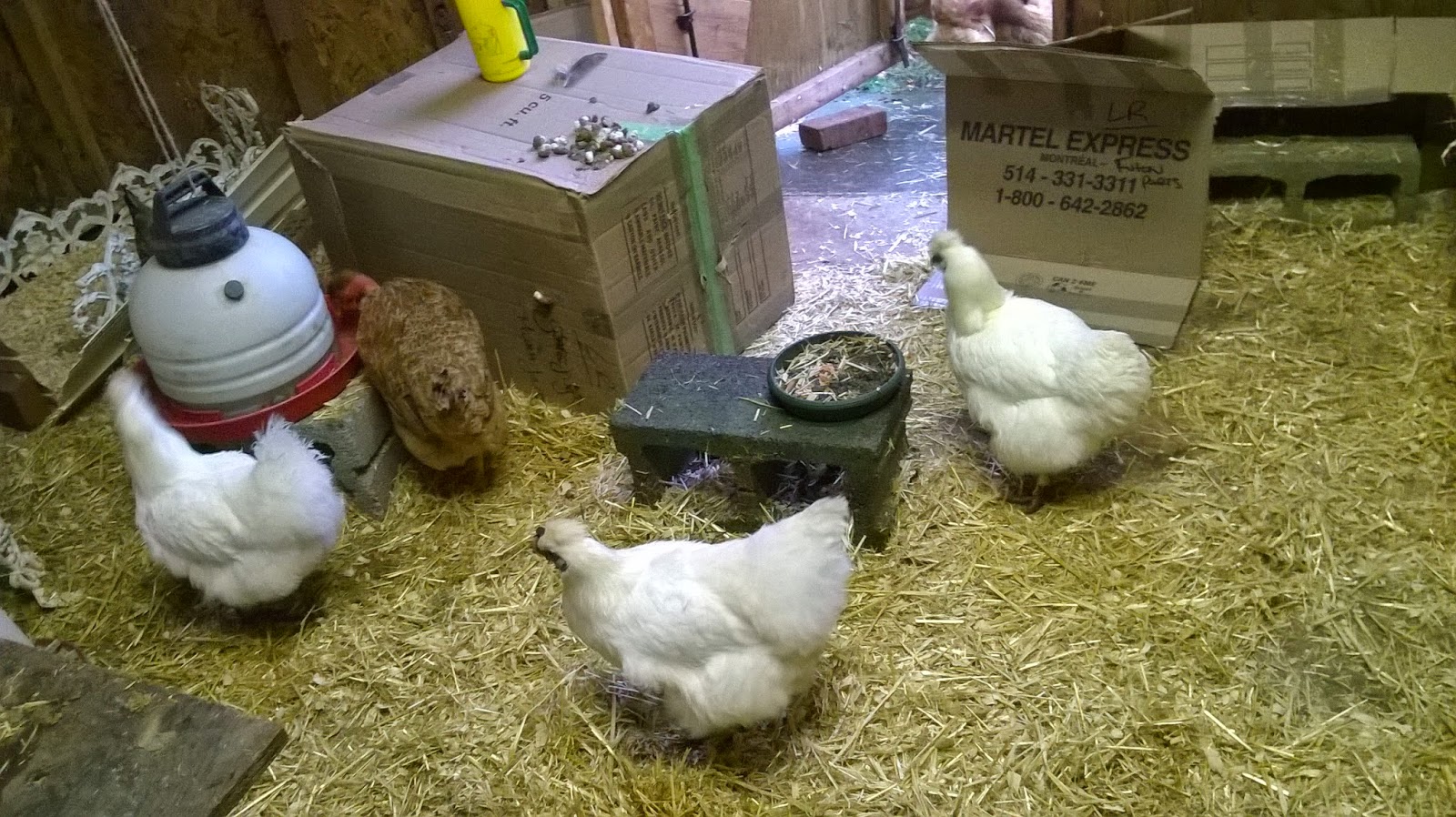 |
| Everyone else is outside in the rain, so the Silkys and Turken take the opportunity to eat some chicken feed. Does this make them the dumbest or the smartest of the flock? |
 |
| It's wet, let's go back in. |
 |
| Horses: "Looks like the neighbors got chickens" "Well, there goes the NEIGH-borhood" |
 |
| Lisa dropped her phone on the way to take more pictures, and now the touch screen only works with a mouse. These will have to do until the new screen arrives. |
1. Hester, Patricia Y., et al. "Can Lighting Programs be Manipulated in the Growing Phase to Improve the Skeletal Integrity of Commercial Egg Layers."
Subscribe to:
Posts (Atom)