Showing posts with label Energy Efficient. Show all posts

Tuesday, June 23, 2015

Energy Efficient Refrigerator Update: Four months on

This is an update for our earlier post Energy Efficient Refrigerator Hack.

So were we crazy to give up our old fridge?  

Pros:

On the utility bill side, there's no question that the new set-up, even with the addition of a separate chest freezer for actual freezing, is working.  Our daily household energy consumption (data provided by our utility company) dropped by a little more than 5 kwh immediately following the switch. In our area, that works out to about $20 a month, or 19 months for the energy savings to entirely pay for the purchase of two new chest freezers and a temperature controller.  We also got a $50 rebate from our utility provider for recycling the mechanical parts of our old fridge (not included in above calculation).  If you only account for the cost of the temperature controller and chest freezer we turned into a refrigerator the payoff is more like 10 months.

Note that our old fridge was a twenty year old behemoth and the door didn't always close correctly, so this is possibly an extreme case for savings potential.

Aside from the energy savings and the new energy efficient fridge, we also got a chest freezer out of the deal that we are actually using. Is freezing tomatoes more energy efficient than canning them on a propane stove?

We're also still liking the narrow profile, counter-like function/feel of the chest refrigerator in our small kitchen.  If we ever redo our kitchen, we'll probably put the fridge on castors and have it roll out from underneath a counter.  For now, its nice to have the fridge double as the one counter top that we always keep clear of stuff.

Cons:

Traditional stand-up refrigerators are more expensive because they come with some features that a hacked chest refrigerator lacks, e.g., dehumidification, even temperature control.

This means that a) the bottom of our chest refrigerator accumulates water and b) no matter how much we fiddle with the temperature control settings, the bottom is colder than the top.

In normal refrigerators and freezers with a defrost setting, excess moisture drips down into a drain at the bottom and goes into a condensate pan underneath.  In freezers without auto defrost the moisture builds up as layers of ice on the sides that you then occasionally scrape off.

In our chest refrigerator, the moisture just drips down into the bottom and stays there.  This means that we have to take everything out of the fridge once a month and wipe up the water.

We haven't really had a chance to notice if food is spoiling faster because of this yet (mostly because food doesn't stick around very long in our house). We did make an additional investment in a nice tupperware set and are trying to be good about making sure everything in the fridge is wrapped up tightly so as not to add more water.

Wiping up the water at the bottom is honestly a pain, but it does force us to pull out the stuff we're not likely to use and feed it to the chickens and wipe down and sanitize the sides of the fridge on a regular basis.  

Someone told us that we should look into getting a small dehumidifier of the type used for snake tanks, but we haven't looked into this yet.

Now for awkward temperature control:

Basically there is no real solution for this.  The bottom of the chest refrigerator will always be colder than the top, sometimes even frozen.  It took a bit of fiddling with the temperature controller to find a sweet spot where the top of our fridge is just cold enough and the bottom is just above icy.  We still do sometimes see ice on the bottom depending on where the fridge is in its cooling cycle.  We've dealt with this by basically not keeping much in the very bottom (except for things like lemon juice or flour, where it doesn't matter if it freezes and thaws) and keeping things that we use faster or that don't need to be kept as cold in the baskets at the top.  This also helps prevent us from forgetting about things on the bottom and letting them spoil, since most of the things we keep down there don't have expiration dates.

Another downside is that we could never have our kitchen certified for commercial production of anything that has to be kept cold.

In other cons, the chest refrigerator seems to be running very hot, as in, the outside of it is sometimes warm to the touch.  J thinks this is normal, I think its a bit too warm to be normal.  Our chest-freezer-for-freezing isn't as hot, but it is also a smaller and a more efficient model.

So in conclusion, we're still happy with our chest refrigerator (and REALLY happy to have scrapped our  old fridge), but its mostly working for us because of a combination of our lifestyle, the particular layout of our small kitchen, and the fact that we're willing to accept a little bit of inconvenience to make the whole thing work.

Wednesday, February 25, 2015

Energy Efficient Refrigerator Hack

We mentioned in our last update that we are a bit obsessive about energy use.  How obsessive? Prior to all of the drama with our frozen pipes, we made a list of every appliance and phantom load in our house, its likely energy consumption in watts, and how many hours per day each appliance is in use in low, medium, and high energy consumption scenarios.  It looked like this:


We then compared our range of total daily energy consumption from the table to our actual daily energy consumption from our electric company.  The numbers matched up pretty well, although our actual allocation of energy use to specific appliances is just a ball park estimate.

Of course, we could have used an actual energy monitor that plugs into each individual outlet or our circuit breaker, but we don't have one and its probably for the best given our tendency to overanalyze...
 

High scenario: The 'computer' category assumes that we leave our desktop with an old monitor plus two laptops on for 24 hours (and the monitors don't go to sleep).  The heat lamps and light in our well house are only on when its cold, but when it is, they're on all night.  We're assuming that its cold AND wet, since the sump pump in this scenario is also working pretty hard.  "Plants" refers to the fluorescent grow lights we use for seedlings.  Our oven is gas powered, but has some auxiliary electric. We don't have cable or TV (see computers), which would be big energy consumers if we did.

What stands out in all of our energy use scenarios is that our ancient water heater and refrigerator account for over half of our electric bill. 

The water heater is going to have to wait for a little bit, as its a slightly larger purchase that will involve some professional plumbing and electric help and the payoff for switching it out isn't as immediate.

However, any excuse to get rid of the old, loud, big, in the way, difficult to close refrigerator! We did some research and what we found was disappointing.  The most efficient Energy Star non-dorm sized refrigerators (over 7cu ft) start at 249 kWh/yr, with most using over 300 kWh/yr.  That isn't so much, but in comparison, similarly sized chest freezers start at 189 kWh/yr to keep food substantially colder.

Most of the difference has to do with the basic layout.  When you open a chest freezer, most of the cold air stays down at the bottom, whereas when you open a standard refrigerator door, all of the cold air comes pouring out towards you.  The chest freezer is also better insulated and you never have to worry about the door popping open (unless you over pack it).

Chest freezers are also substantially cheaper, as they are basically just a box.  No shelves.  No drink dispenser.  No ice maker.  Just box.

So we did some thinking.  Our kitchen is small and limited in counter space.  Pretty much any upright refrigerator would partially block our lovely wall cabinet.  How attached were we to conventional shelves?  We pretty much only use the front 6" inches...the backs of the shelves being a graveyard for unlabeled jars and old mustard.  Did we want a drink dispenser? no.  Did we want an ice maker? no.  Did we even want a freezer compartment?

An investigation of our freezer revealed 10 ice packs, a single Tupperware of frozen berries, and 6 zip lock bags of malted barley from the last time we made beer.  But what if someday we want to buy ice cream?  What if someday we actually have leftovers that stick around for more than two days?

We ultimately decided on buying two chest freezers and a temperature controller (still cheaper than one refrigerator).  The larger chest freezer came with an energy rating of 248 kWh/yr.  Not particularly good for a freezer, but still better than the best refrigerator, and for our purposes it doesn't really matter.  We hooked it up to the temperature controller, and voila...a 7.2 cu ft, better than 248 kWh/yr, refrigerator.

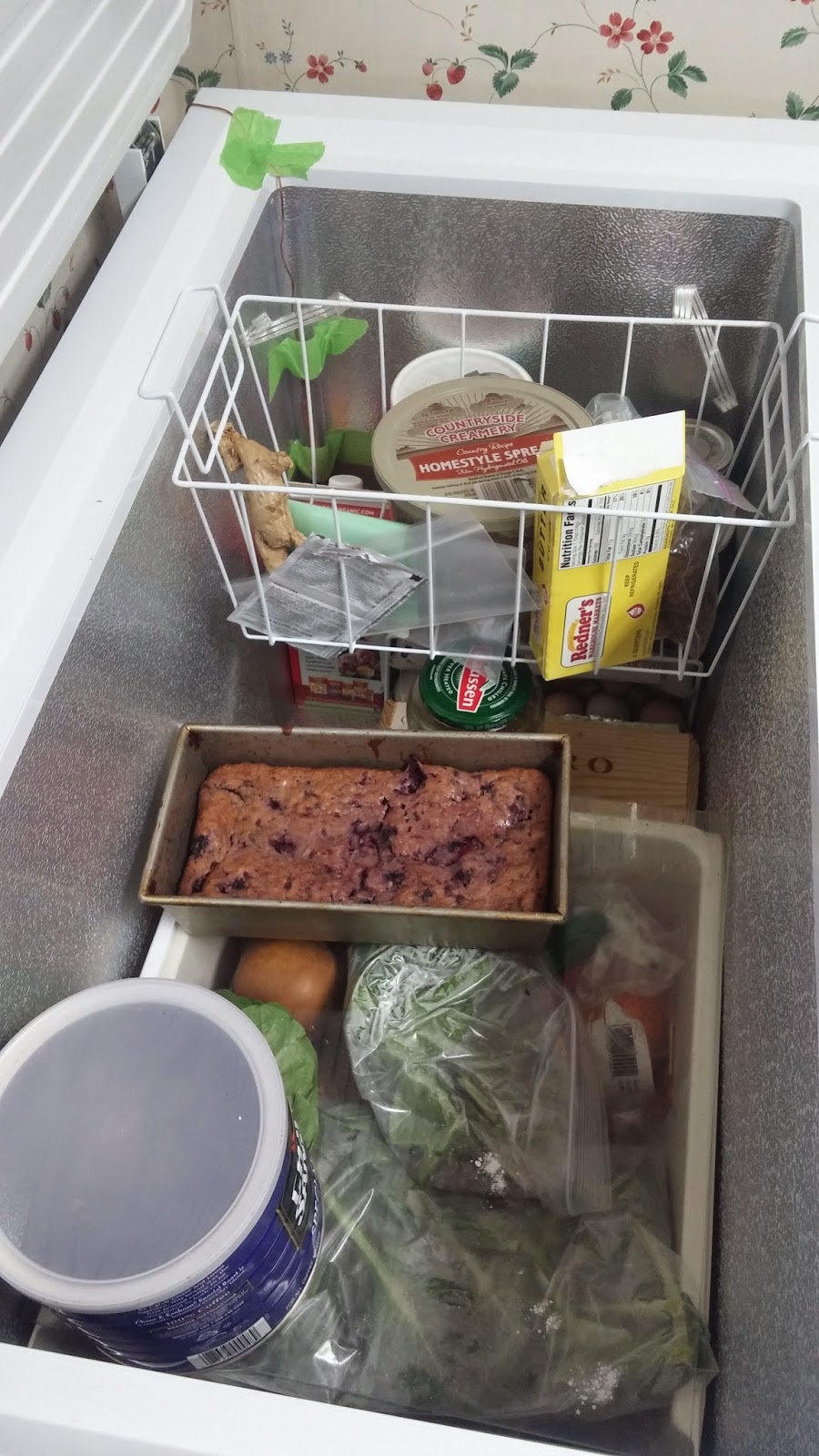
We stripped our old refrigerator of its shelves and made a sort of sliding box system inside of the chest freezer...ahem...refrigerator. 

Somehow I never took a good picture of our old refrigerator before we moved it, so this is the most comparable before-after I can come up with:

            Before                                                    After

You can see the discoloration on the floor where the old refrigerator used to be.  The new chest refrigerator takes up about the same floor area as the old refrigerator, just in a slightly different orientation.

In the back corner we have the temperature sensor part of the temperature controller hanging inside of a plastic tube we happened to have (for protection) and not so neatly taped in place with painter's tape.  The actual temperature regulator sits in the corner behind the refrigerator.


On the top layer we have a basket that slides from side to side.  We're looking for a few more baskets with compartments to organize and store things we use often more securely.  The current basket is a bit of a mess.
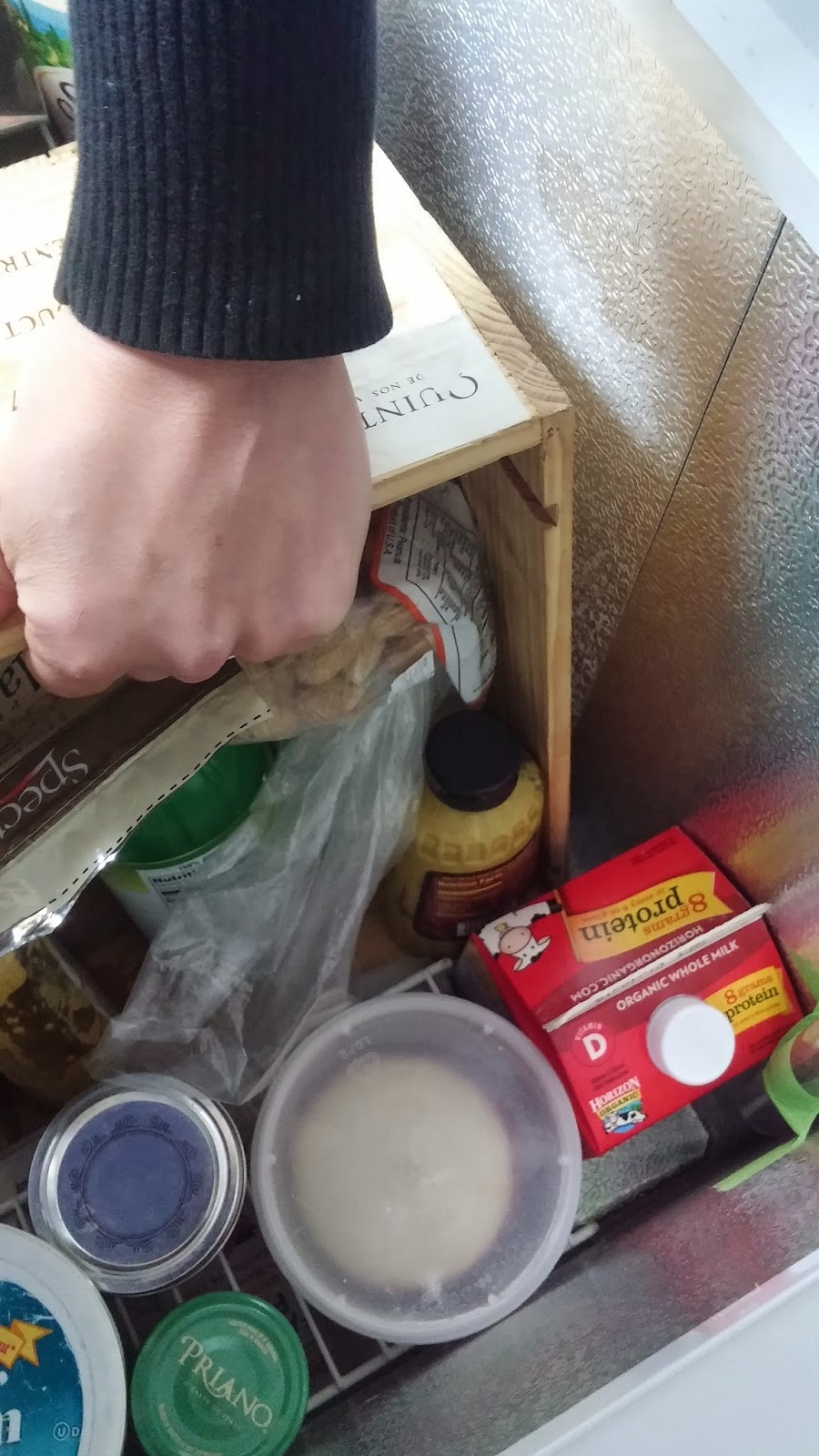
On the second layer, we have a drawer from our old refrigerator (with glass shelf on top for a cover).  The glass cover slides over to give access to the contents of the drawer.  The entire drawer also slides out of the way to give access to a third layer (milk crate covered with freezer shelf).


For now we also have another crate on the bottom layer that can be lifted up to rest on the built in ledge

Kind of a clunky first pass at organization with materials we have lying around.   Once we have an idea of what works well for us we'll think about building something more permanent.  This is probably as full as our refrigerator will ever get, since we had an amazing, large CSA basket gifted to us today by the same incredible person that helped us track down a plumber.
As for the freezer, we ordered a smaller Energy Star chest freezer that we'll keep somewhere out of the way and only use as we need it (or get a second temperature controller so it can double as an overflow fridge).   We ate the berries we had frozen and are feeding the defrosted malted barley to the chickens (who LOVE it).


Some of the other old refrigerator shelves have temporarily been installed in our utility/laundry room to hold our garden seedlings.  No shelf in our house is safe from plants!

Keep reading: